Curtain Bangs on Every Face Shape: 16 Examples to See Before You Cut
Curtain bangs suit nearly every face shape when the length and angle are adjusted. Sixteen examples by face shape, plus how to style them and grow them out.
By Lock & Luster Editors · October 18, 2026

Yes, curtain bangs can suit your face shape, whichever one you have. That is the whole secret of their popularity: a curtain fringe is not one fixed cut but a family of them, and the two dials your stylist turns, the length of the shortest point and the angle of the sweep, are set differently for a round face than for a long one. Get those two dials right and the bangs flatter almost everyone.
Below are sixteen examples organized by face shape, so you can find your section, save your two or three favourites, and walk into the salon knowing exactly what to ask for. If the appointment doubles as a color day, keep our chocolate brown hair color ideas for every skin tone open as well: a soft fringe over rich brunette dimension is the pairing salons photograph most.
What are curtain bangs, exactly?
Curtain bangs are a center parted fringe cut shorter in the middle and longer at the edges, so the hair opens like a pair of curtains and blends into the sides. The shortest point usually lands between the eyebrows and the cheekbones, and the longest edges melt into your length around the jaw. Unlike a straight across fringe, there is no hard line, which is why the style grows out gracefully and suits so many faces.
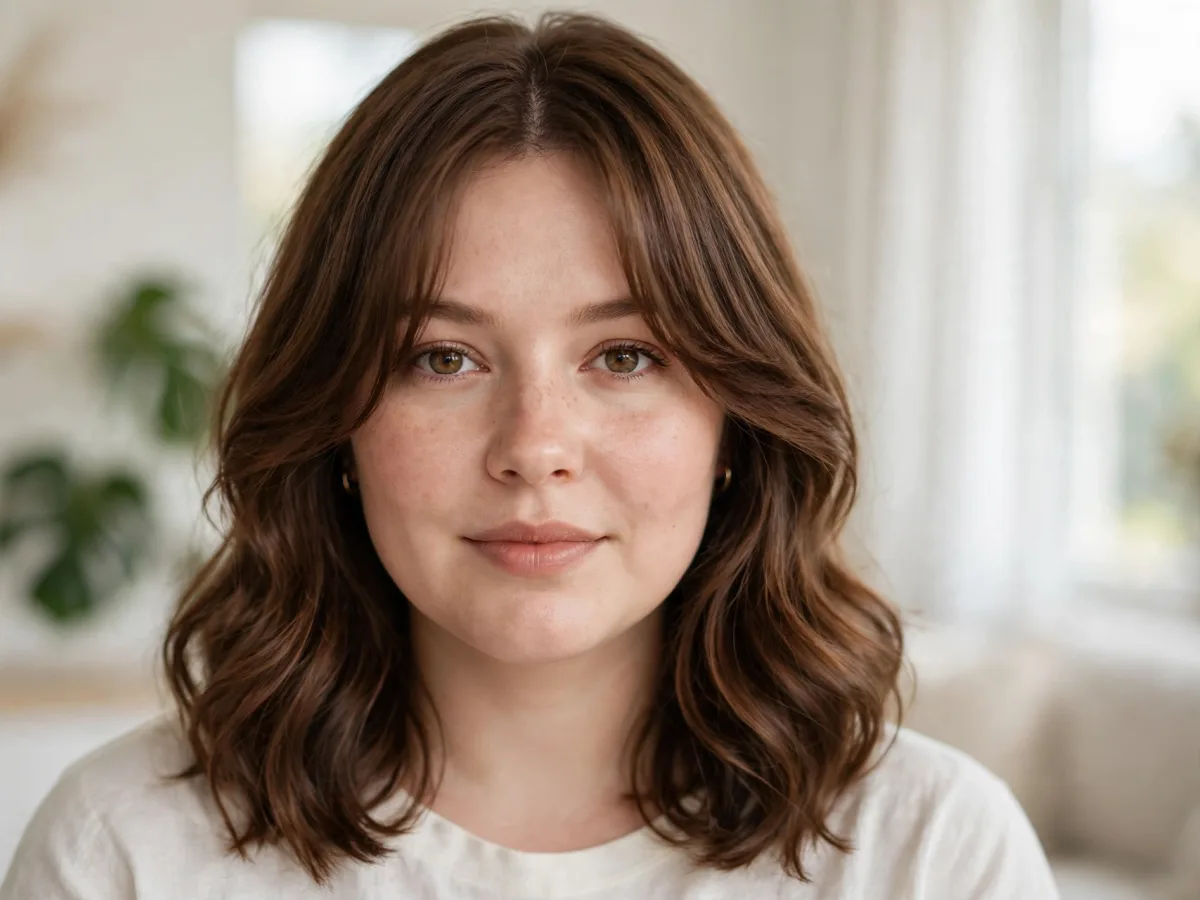
Curtain bangs for round faces
Round faces want length and angles, anything that draws the eye downward and adds a gentle diagonal. Keep the shortest point at or below the cheekbones and let the wings fall long.
1. The long, cheek skimming curtain
The shortest pieces land right at the cheekbones and the edges continue to the jaw. The two long diagonals slim the cheeks and the center opening shows just enough forehead to keep the face from reading as a circle.
2. The deep sweep curtain
Cut to be worn pushed further to the sides, almost like long face framing layers with a fringe beginning. The extra length is the most slimming version of the cut for round faces.
3. The wispy center curtain
A lighter, feathered take with a softer middle. On round faces the wispiness keeps the style from adding width, and it is the most forgiving first fringe if you are nervous.
Curtain bangs for oval faces
Oval faces are the easy case: the proportions suit nearly every version of the cut. This is the shape to experiment on.
4. The classic seventies curtain
Shortest point at the cheekbones, bouncy, flicked back at the ends. This is the reference photo most people save, and on an oval face it lands exactly as pictured.
5. The brow grazing curtain
A shorter, bolder cut where the middle pieces brush the eyebrows. It draws all the attention to the eyes and works beautifully with long hair worn loose.
6. The soft micro curtain
Very short in the center, quickly lengthening at the edges. Playful and modern, it suits oval faces because nothing about the balance needs correcting.
Curtain bangs for square faces
Square faces want softness at the corners. The fringe should be curved, airy, and long enough to blur the strong jaw and forehead lines.
7. The soft arched curtain
Cut in a gentle arch, longer toward the temples, with feathered ends. The curve counteracts a straight, strong hairline and the softness spills down the sides of the face.
8. The textured, piecey curtain
Point cut and deliberately separated, worn slightly messy. Texture breaks up straight lines, which is exactly what a square face benefits from, and it is the lowest maintenance version on this list.
9. The long side blending curtain
A longer fringe that merges into layers at the jaw. The continuous sweep past the jawline softens its corners and frames the face in one unbroken line.
Curtain bangs for heart shaped faces
Heart shaped faces pair a wider forehead with a narrower chin, so the fringe should fill a little at the sides and keep the chin area free.
10. The full, brow skimming curtain
A slightly fuller section through the middle that balances a wide forehead, with the edges kept light so they do not widen the top of the face further.
11. The narrow center curtain
A slimmer fringe section that shows more forehead at the sides. It suits hearts who find classic curtains too heavy, and it keeps the focus on the eyes.
12. The curtain with chin length layers
Curtain bangs plus face framing layers that end right at the chin. The layers add a whisper of width at the narrowest point of the face, and the whole combination looks effortlessly balanced.
Curtain bangs for long faces
Long faces want width and a horizontal element. The fringe can be shorter and fuller here, because breaking up the length is the goal.
13. The short, full curtain
The shortest point sits high, near the eyebrows, and the section is taken a little deeper. The strong horizontal of the fringe visually shortens the face more than any other example here.
14. The wide sweeping curtain
Wings swept dramatically outward toward the cheekbones and ears. The outward flick creates width at the sides, which is precisely the correction a long face enjoys.
Curtain bangs for diamond faces
Diamond faces are widest at the cheekbones with a narrower forehead and jaw, so the fringe should add softness at the top without hiding those cheekbones, they are the feature.
15. The light, open curtain
A fine, airy fringe that shows the forehead through it. It softens the top of the face while leaving the cheekbones, the widest and prettiest point, completely on display.
16. The side melting curtain
Cut to sweep diagonally into longer side pieces. The diagonal distracts from the narrow jaw and gives the whole face a softer outline, and it grows out into beautiful face framing layers.

How do you style curtain bangs at home?
The routine stylists teach is genuinely two minutes. Start with damp bangs, because curtain bangs are set as they dry and are stubborn once dry. Dry them forward and flat against your forehead first, pointing the dryer downward from above; this kills any cowlick and sets the roots in the right direction. Then, with a round brush or your fingers, sweep each side back and away from the face so the wings open. If you use a round brush, roll it under the fringe and pull it forward and out, letting the ends flick. Finish with the cool shot if your dryer has one. On day two, a thirty second re dampen and repeat is usually all it takes.
The rule underneath all sixteen: the fringe is a frame, not a feature. Cut it to correct your face shape quietly and it will flatter you in every photo, from every angle.
How do you grow them out if you change your mind?
Gracefully, which is the design. In the first month the wings simply read as face framing layers. If your length is due a refresh at the same appointment, the cuts in our guide to shoulder length hairstyles that make thin hair look fuller are the ones that carry a growing out fringe best. By month two or three, ask your stylist to blend the shortest pieces into layers at your next trim so there is no shelf as they descend. Side parts, soft clips and the occasional twist pin cover any awkward week. Most people find curtain bangs are the one fringe they never have to hide with a headband while they grow. For more cuts sorted the same way, browse our hairstyle ideas by length and face shape.
Questions, answered
Will curtain bangs work on thin or fine hair? +
Yes, and they are often kinder to fine hair than a straight fringe, because they are cut from a smaller section and worn in two soft wings rather than one heavy shelf. Ask your stylist to keep the section shallow, so the fringe does not steal too much hair from the sides.
How much maintenance do curtain bangs need? +
Less than most bangs. The shape is forgiving as it grows, and most people need a small trim every four to six weeks to keep the shortest point near the cheekbones. Many salons offer quick fringe trims between full appointments, and the daily styling takes about two minutes.
Do curtain bangs work with glasses? +
They can work beautifully. The trick is length: the wings should be cut to sweep at or below the cheekbones so they clear or softly touch the frames rather than poking into them. Bring your glasses to the appointment and let your stylist cut around them.
What if I have a strong cowlick at the front? +
Tell your stylist before they cut. A cowlick pushes the fringe to open at a certain point, and a good stylist will cut the bangs slightly longer and heavier so the weight settles the swirl, and will show you the drying direction that trains it down.
How long do curtain bangs take to grow out? +
Because they start longer than a classic fringe, they blend into face framing layers within a few months and disappear into your length within about six months for most people. Growing them out is the easiest of any bang style, which is why they are the fringe stylists suggest to the fringe nervous.